Abstract
Embodied question answering (EQA) is traditionally evaluated under an episodic formulation, where agents solve each task independently and reset internal state between episodes. However, real-world robots operate continuously and must accumulate, retain, and selectively reuse information acquired from prior interactions. Despite this practical requirement, the architectural mechanisms needed to support sequential memory in EQA remain underexplored.
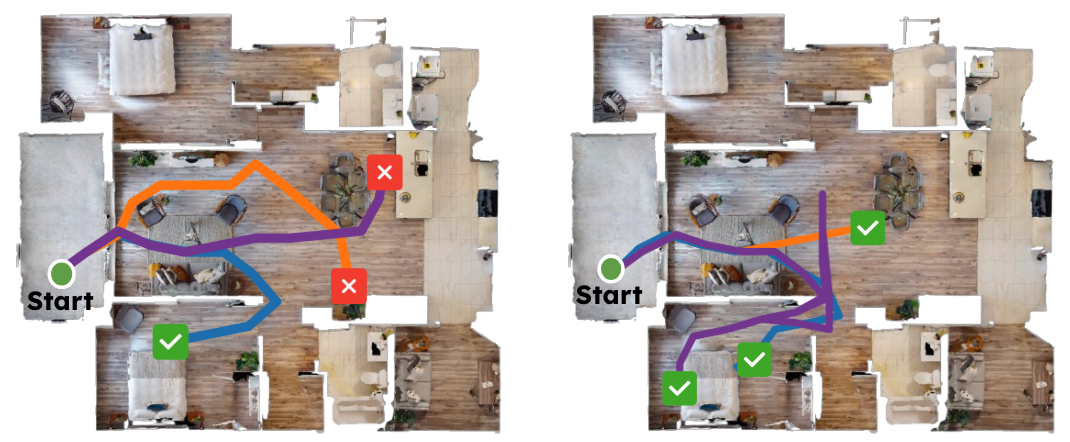
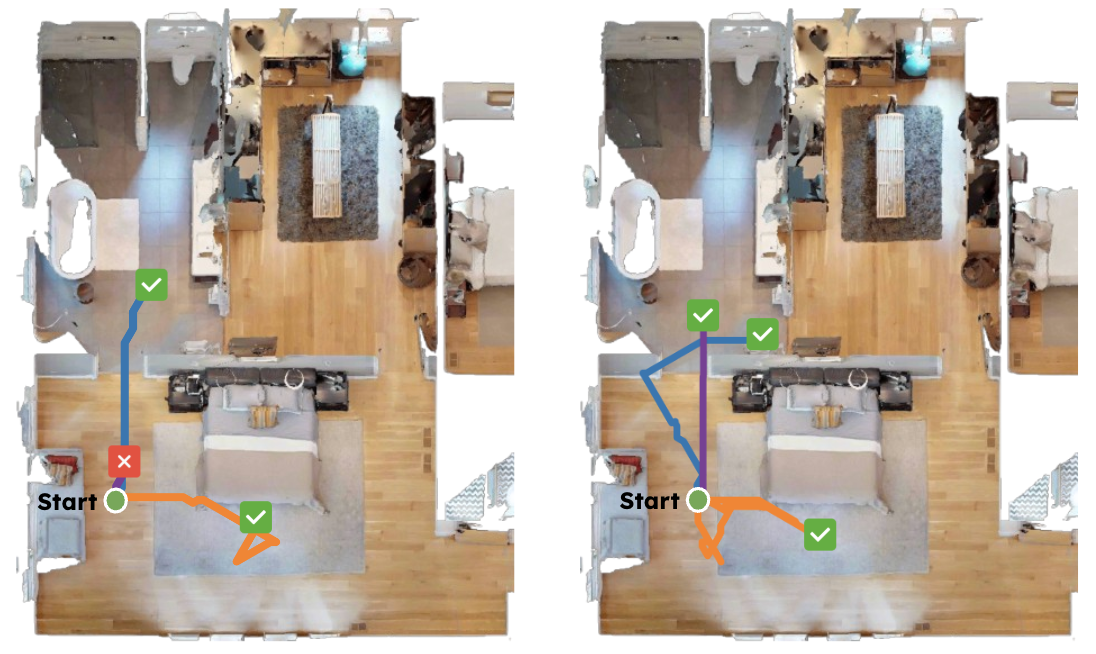
In this work, we investigate how different memory architectures behave when EQA agents are evaluated sequentially — with multiple questions answered in the same scene while memory is carried forward across queries. We find that simply preserving existing memory is often insufficient. Agents that retain only traversability information, such as 2D occupancy maps, remember where the robot explored but not the visual-semantic evidence needed for later questions. Agents trained on short-horizon episodic data face a different challenge: continuous, multi-query histories put their inherited context out of distribution rather than forming a reusable scene representation.
To overcome this bottleneck, we highlight the necessity of structured, spatially grounded memory: architectures that map persistent visual observations onto metric 3D geometry preserve visual-semantic evidence in a coherent scene representation. Extensive experiments in simulation show that this form of memory breaks the accuracy–efficiency tradeoff in sequential settings, simultaneously achieving higher answer accuracy and lower navigation cost. We further validate these findings on a real-world mobile robot, demonstrating that spatially grounded visual memory is critical for continuous, intelligent operation in physical environments.
Key takeaways
Persistence ≠ Accumulation
Merely retaining state across sequential queries does not guarantee that useful environmental knowledge is being accumulated.
Spatial grounding is critical
Only spatially grounded memory reliably turns accumulated observations into simultaneous gains in answer accuracy and navigation efficiency.
Efficiency ≠ success
Shorter paths do not imply better reasoning. Unstructured memory can bias an agent to stop early in familiar regions before finding the right evidence.
Structure compounds
Structuring observations geometrically lets the agent's representation become progressively more useful over later queries in the sequence.
The protocol
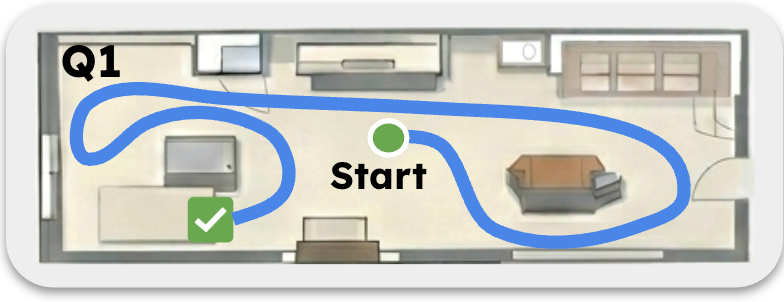
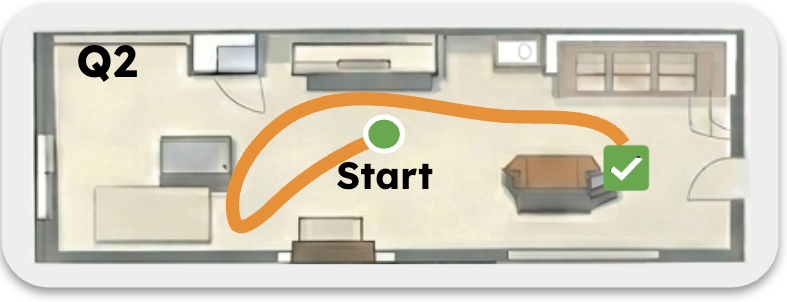
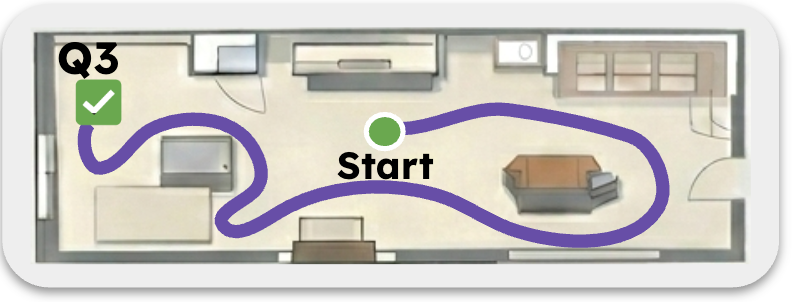
We convert a widely used episodic benchmark (OpenEQA) into a sequential one without touching the environments, questions, or model weights. Questions from the same scene are grouped into one shuffled-but-fixed-order sequence, and the agent's internal memory is carried across them with no truncation or summarization.
At each question boundary we do exactly three things: inherit the terminal memory state as the next initial state, update the query and re-initialize any goal-directed planner, and keep all weights frozen. Any performance difference between episodic and sequential conditions is therefore attributable solely to the structure of the inherited representation — not to learned sequential behavior.
Benchmark: 50 scenes · 498 questions, sequences of 6–14 (most 10–13). Foundation model: Qwen3-VL 8B-Instruct (FP8) on A5000 GPUs.
Evaluated architectures
VLM-agent methods keep a frozen vision-language model and engineer memory around it; VLA methods fine-tune the model to output actions, with memory implicit in a short-horizon hidden state.
| Method | Paradigm | What is stored | Retrieval mechanism |
|---|---|---|---|
| ExploreEQA | VLM-Agent | Occupancy + frontier scores | Frontier ranking by VLM |
| MemoryEQA | VLM-Agent | RGB + pose + language description + embedding | Entropy-based adaptive retrieval |
| 3D-Memwinner | VLM-Agent | 3D point cloud + visual embeddings | Spatially indexed 3D lookup |
| UniNavid | VLA | Transformer hidden state | Implicit attention |
Table 1. Only 3D-Mem fuses observations into a single spatially consistent representation. ExploreEQA keeps geometry but no semantics; MemoryEQA keeps rich but unfused pose-tagged events; UniNavid keeps only a short implicit window.
Main results
| Method | SR | SRmem | MA | PL | PLmem | SA |
|---|---|---|---|---|---|---|
| ExploreEQA | 43.8 | 46.5 | +2.7 | 84.3 | 84.3 | 0.0 |
| MemoryEQA | 61.0 | 62.4 | +1.4 | 43.6 | 43.9 | −0.5 |
| 3D-Mem | 25.5 | 58.8 | +33.3 | 5.6 | 2.6 | +53.3 |
| UniNavid | 36.4 | 37.3 | +0.9 | 12.2 | 12.4 | −1.5 |
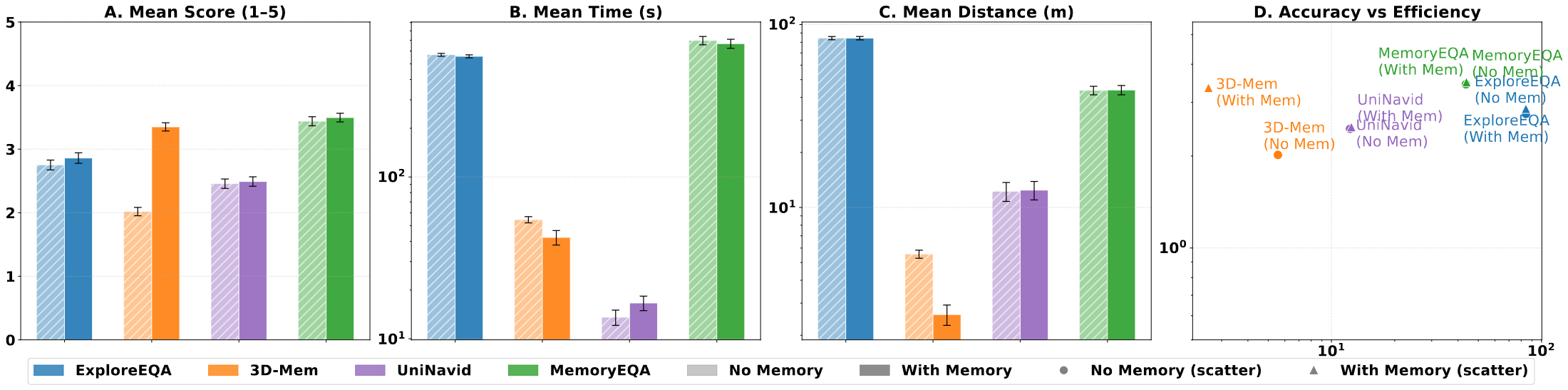
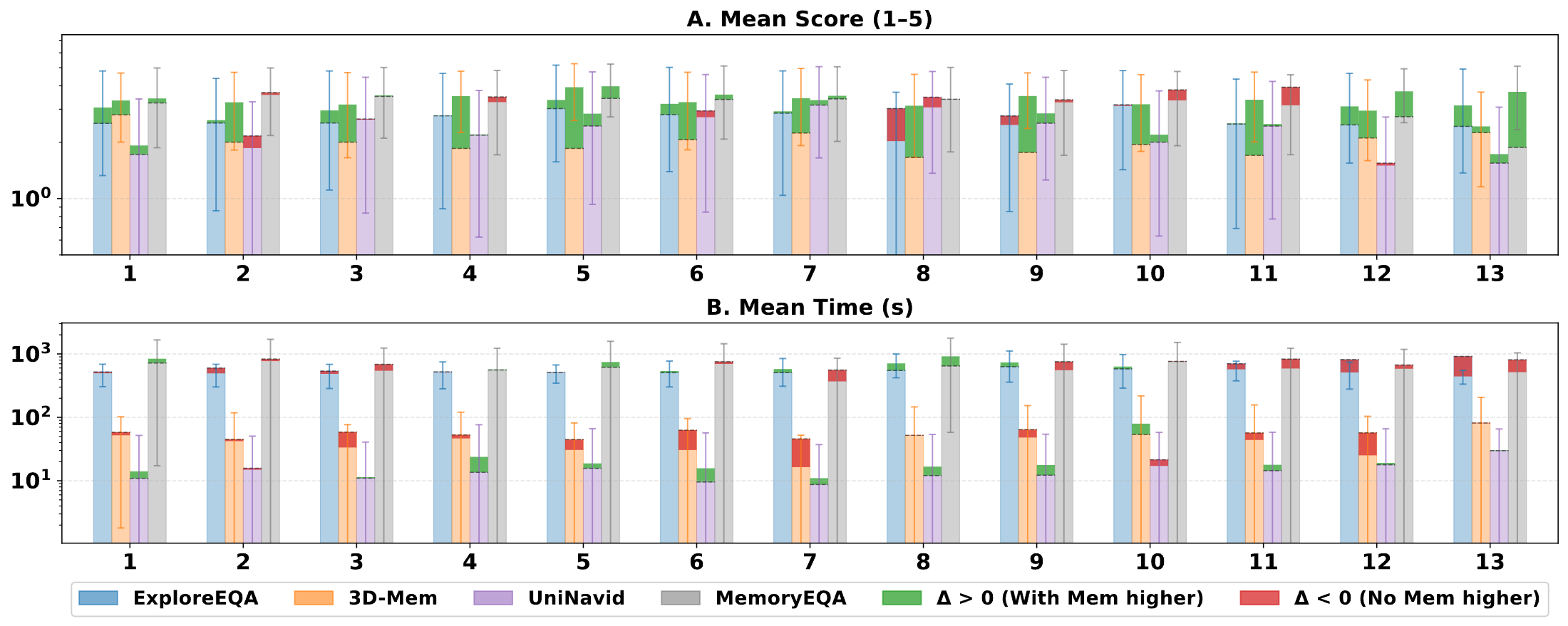
Table 2. Success rates under episodic (SR) and sequential (SRmem) conditions, memory advantage (MA), path lengths (PL / PLmem) and step advantage (SA). Three of four architectures show near-zero MA; 3D-Mem gains +33.3 points of accuracy while cutting navigation cost by 53.3%.
Each arrow runs from episodic (hollow) to sequential (filled). Up-and-left is better.
Figure 2. The x-axis is total path length in meters (log scale, lower is better); the y-axis is success rate. Persisting memory shifts most methods horizontally at best — only 3D-Mem climbs toward the high-accuracy, low-cost corner. A table view of the same numbers is in Table 2 above.
Real-robot validation
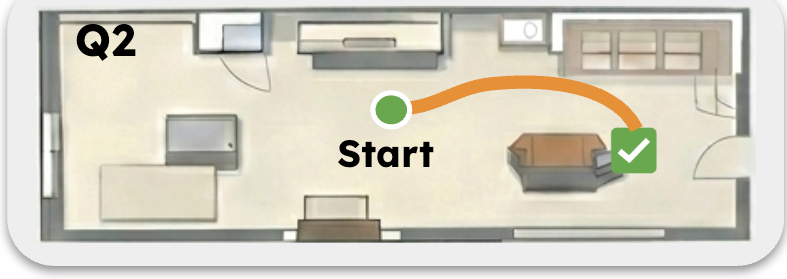
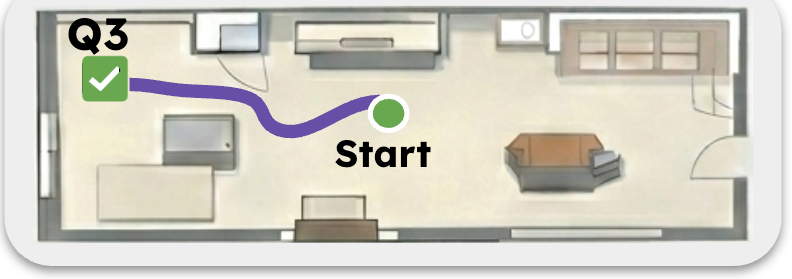
We deploy a Unitree Go2 quadruped with an Intel RealSense D435i depth camera and onboard LiDAR L2, and run all four methods episodically and sequentially across a furnished indoor lab, an open lobby, and a long hallway (plus an outdoor rooftop terrace for UniNavid). Each trial is five spatially dependent questions spanning object identification, counting, and localization.
Physical sensing noise and actuation drift amplify weak memory rather than mitigating it. Without a structured map, the agent has no stable reference for deciding whether a later query can be answered from prior evidence — UniNavid re-navigates to the same chair as if the first encounter never happened, and rotates erratically before answering. Only the spatially grounded architecture improves when memory is preserved.
| Method | Episodic | Sequential |
|---|---|---|
| 3D-Mem | 20% | 40% |
| MemoryEQA | 40% | 47% |
| ExploreEQA | 33% | 26% |
| UniNavid | 15% | 15% |
3D-Mem doubles its success rate with memory on, mirroring simulation. ExploreEQA's dip is within the small-sample noise of five-question trials.
Citation
@inproceedings{cai2026beyond,
title = {Beyond Episodic Evaluation: Memory Architectural Bottlenecks
in Sequential Embodied Question Answering},
author = {Cai, Zikui and Janga, Kaushal and Dao, Tan Dat and Lee, Seungjae
and Dass, Shivin and Seo, Mingyo and Yue, Kaiyu and Kang, Mintong
and Pillai, Nandhu and Hoover, Monte and Palnitkar, Aadi
and Rawal, Ruchit and Zheng, Ruijie and Li, Bo and Zhu, Yuke
and Mart{\'i}n-Mart{\'i}n, Roberto and Goldstein, Tom
and Huang, Furong},
booktitle = {IEEE/RSJ International Conference on Intelligent Robots
and Systems (IROS)},
year = {2026}
}